Telling Trinity’s Story
Telling Trinity's Story: Our New Visual Identity
Last year, two conversations were happening simultaneously at Trinity and they kept pointing in the same direction.
The Outreach Committee had been talking for months about the need for a new approach to our online presence. More and more, the first contact a household has with a congregation like ours isn't a knock on the door or a referral from a neighbor — it's a Google search, a scroll through social media, a glance at a website. If we want to invite people into community with us, we need to show up where they're already looking.
The team identified three things Trinity needed, and we started talking about them in terms of a house. The porch is our social media presence — what grabs someone's attention and draws them to the door. The living room is our website — easy to navigate, kept current and accurate, telling the story of who we are and what someone can expect when they walk through our doors. And the kitchen is our Church Management System, the behind-the-scenes software that makes communication between staff, members, and ministry teams simpler and more effective. You can have a welcoming porch and a beautiful living room, but if the kitchen isn't working, the household struggles.
At the same time, a Technology and Communications Task Force had been assessing Trinity's hardware and software systems, asking what we would need to make our online presence, especially our Sunday morning worship, more consistent and accessible to people watching from home or finding us for the first time.
These two conversations came together in the 2025–2026 Ministry Plan, launched in July 2025. One of the plan's clear conclusions was that we needed outside expertise to help us implement it well. We began looking for the right partner.
Evoke Communications (evokexperts.com) came to us highly recommended, and for good reason: they specialize in working with ELCA Lutheran congregations across the country. One of the things I've appreciated most in working with them is that we don't have to explain who we are or what we stand for. They understand church, and they understand our particular expression of it. They also bring perspective from congregations like ours all over the country, which means we get to learn from what others are trying rather than figuring it all out on our own.
Among the first things Evoke stressed was the importance of a visual identity. Before we could update the website or refresh our social media, we needed a clear and coherent sense of how Trinity presents itself to the world.
A visual identity is more than a logo. It's the full personality of an organization's visual presence: the colors, fonts, imagery, patterns, and style of photography and communication that appear across everything from bulletins to social media to the website. When these elements work together consistently, they say something that feels true about who we are before a single word is read.
Emily Christenson, Co-Owner and Creative Director at Evoke, led us through the process. She started not with design, but with listening. She invited us to reflect on Trinity's core identity — the emotional associations we carry with this place, what longtime members treasure, what newer folks noticed when they first arrived. She gathered those responses and translated them into visuals we could actually see ourselves in.
That work required a team. I was glad to be part of it alongside Carol Wilson, Becca Payne, Marge Blenker, Kate Hunt, Suzie Labelle, Jason Reno, and Joan Sherman. Their willingness to reflect carefully and honestly on who Trinity is shaped the work that followed.
The result is a refreshed visual identity designed to reflect our values and our mission: transforming lives by living the Gospel of Jesus Christ. The goal is to make sure that what people encounter when they find us online, open a mailer, or pick up a bulletin clearly reflects the community they'll meet when they join us in person.
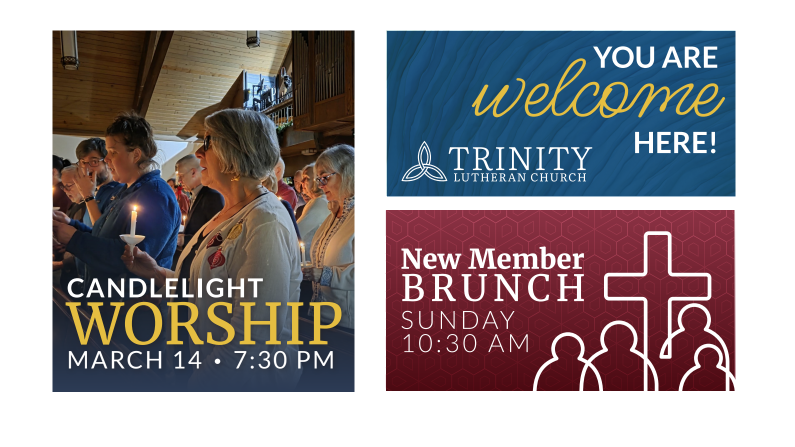
You may already be noticing some of the new elements: updated graphics in weekly emails, a refreshed look on the website, new visuals for events and announcements. More is coming. As new pieces are completed, the visual identity will continue to roll out across Trinity's communications platforms — social media, signage, print materials, and more — until everything feels connected and coherent.
To give a sense of where things stand: right now, our energy is focused on the new visual identity and applying it across our current website and email communications. This summer, we'll launch a more planned and expansive approach to social media. This fall, we'll migrate to a new website platform — one built for the way congregations communicate today. And in early 2027, we'll begin the transition to a new Church Management System. Each step builds on the last.
The visual identity is one of the most visible pieces of our new partnership with Evoke, but there's more happening behind the scenes — building out a 6-month communications calendar, changes to how we communicate news and announcements, and eventually the move to a new Church Management System. Each piece serves the same purpose: making sure that the ministry we're doing together — the worship, the community care, the advocacy, the faith formation — is clearly communicated to those who haven't yet found their way to us.
Trinity has a story worth telling. We're working to tell it as well as we can!
Pastor Erik Christensen