Finding Refuge, Practicing Welcome
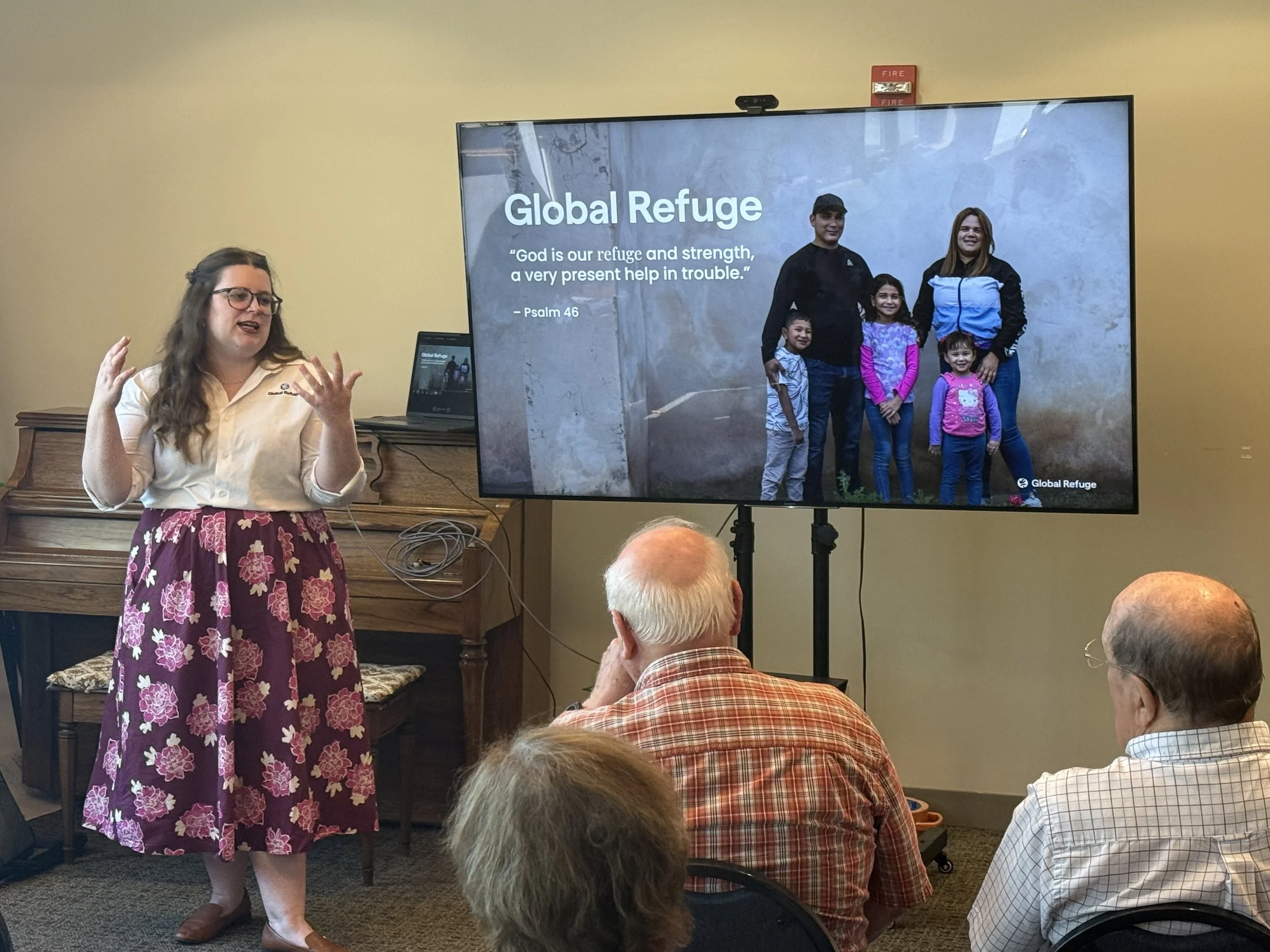
On Sunday, July 12, Trinity welcomed Mackenzie Mahon from Global Refuge for a thoughtful and challenging presentation on refugees, immigration, and what it means to practice welcome in our life together as Christians.
She began with a question. Participants were invited to turn to someone nearby and share about a time when they felt welcomed, or a place where they found refuge. It was a simple but meaningful prompt. Before talking about policy, programs, or headlines, we began with human experience: the deep need to be received, protected, and known.
That opening set the tone for the morning. The presentation invited us to think not only about immigration as a public issue, but also about refuge as a spiritual theme and a congregational calling.
Global Refuge, formerly known as Lutheran Refugee and Immigration Service (LIRS), was founded in 1939 and adopted its new name in 2024. The name comes from Psalm 46: “God is our refuge and strength,” and reflects a desire to serve neighbors broadly, including those beyond Lutheran or Christian communities. Their mission is to stand with and advocate for immigrants and refugees, helping transform communities through service and justice.
The presentation offered a helpful framework for understanding the global displacement crisis. As of 2024, 123.2 million people worldwide were displaced. That includes people displaced within their own countries, refugees who have crossed borders, and asylum seekers pursuing protection. We were reminded that most displaced people are hosted not by wealthy nations, but by low- and middle-income countries.
Mackenzie also clarified important distinctions that are often blurred in public conversation: the difference between immigrants, refugees, and asylum seekers; the internationally-recognized legal right to seek asylum; and the extensive vetting refugees complete before arriving in the United States. The presentation also named several recent legal and policy shifts affecting asylum seekers and other immigrants, along with the sharp decline in refugee admissions compared with historical norms.
Just as importantly, the session challenged several common myths. Participants heard data points about immigrant contributions to the economy, entrepreneurship, healthcare, and tax revenue, alongside polling that suggests support for immigration reform is broader than many people assume.
But the morning was not only about facts. It was also about the concrete work of accompaniment.
Global Refuge’s ministries include refugee resettlement, mental health care, foster care and family reunification support, legal services, small-dollar lending, and partnerships with employers committed to accessibility for refugees. We also learned about Camino a Casa, a program serving repatriated youth in Mexico and Guatemala, with expansion into Honduras.
For Trinity, this conversation felt especially timely. We heard about practical ways congregations can engage: through Global Refuge’s Faith Alliance process, the Ambassador Network, advocacy action alerts, and tangible support such as a school supply drive for refugee students in San Antonio. We also learned that Global Refuge offers legal consultations that may be especially important for individuals or families facing immigration enforcement concerns.
As a congregation, we may leave this event with more than one kind of response.
We may leave with compassion, hearing again the scale of displacement in our world. We may leave with gratitude, remembering times when we ourselves were welcomed. We may leave with questions about law, policy, and public life. And we may leave with a renewed sense that Christian hospitality is not only a feeling, but a practice.
Here are a few questions worth carrying forward:
When have you experienced refuge in a time of uncertainty?
What does Christian welcome require beyond kind words?
How might Trinity’s ministry become more visible, intentional, and practical in its care for immigrants and refugees?
What assumptions do we carry about immigration that need to be tested by real stories, trusted facts, and faith?
And here are a few next steps our congregation might consider:
sharing Global Refuge’s legal services information with those who may need it
exploring the Faith Alliance program at Trinity
participating in advocacy opportunities
supporting the San Antonio school supply drive
We are grateful to Mackenzie Mahon and Global Refuge for helping us learn, reflect, and imagine faithful action. In a world marked by displacement and division, the call to welcome remains both deeply biblical and urgently contemporary.